

- What Is a Circlip and How Does It Work?
- Types of Circlips Used in Industrial Applications
- Key Factors to Consider When Choosing a Circlip
- Common Industrial Applications of Circlips
- Why Quality Matters When Buying Industrial Circlips
- How to Choose Reliable Circlip Suppliers
- Common Mistakes to Avoid When Selecting Circlips
- Conclusion: Choose the Right Circlip for Reliable Performance
A small ring may just keep an entire assembly from coming apart. That is the purpose of a circlip. Very small, very cheap, and very easy to overlook. Choose the wrong one, and your bearing moves out of place, your gear slips from the shaft, and production halts. This article will give information about industrial circlips, types, and things to look for when purchasing. Easco has been manufacturing fasteners for over 55 years; we know what happens on the factory floor.
What Is a Circlip and How Does It Work?
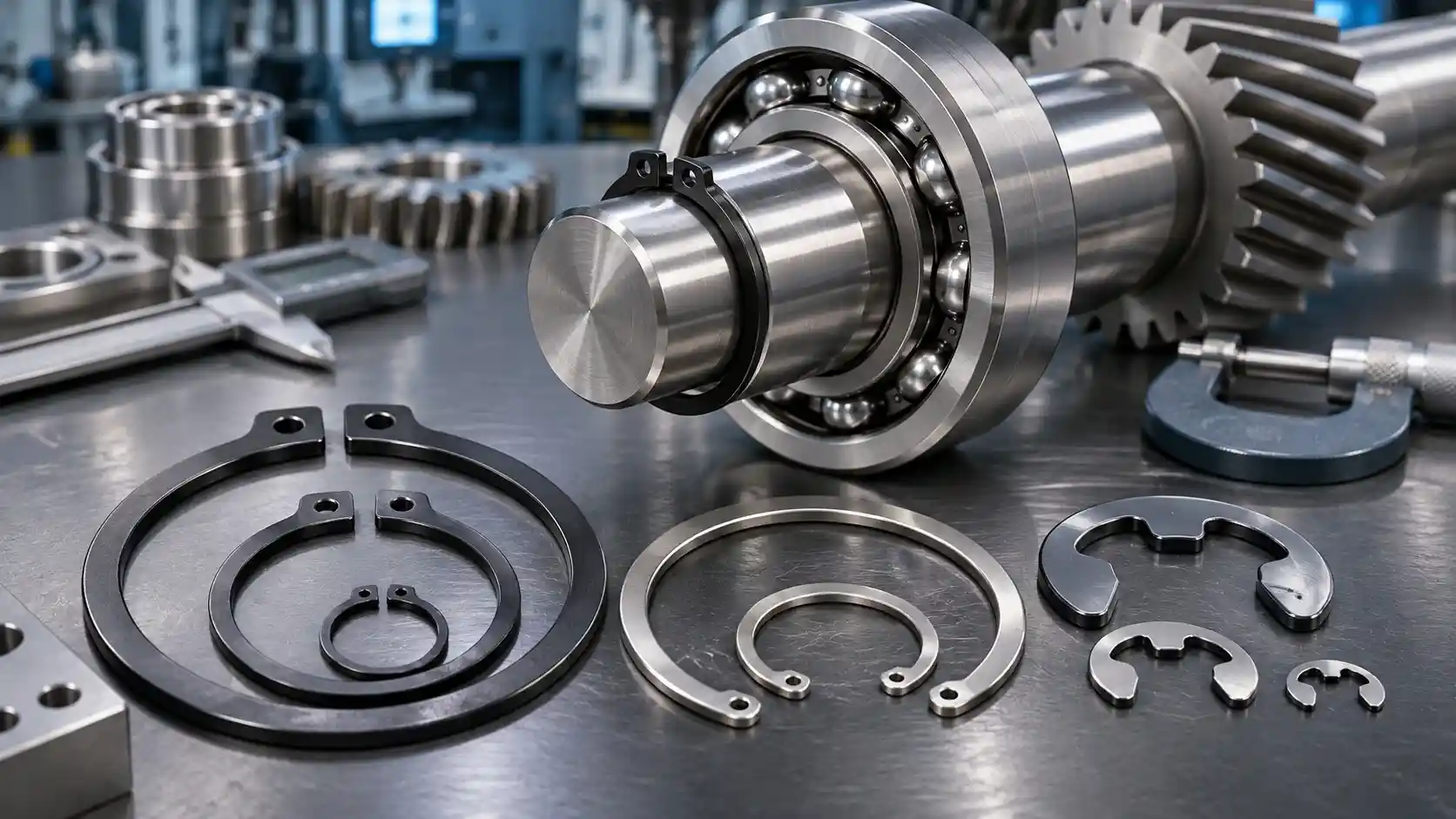
A circlip is a split ring of spring steel, also called a retaining ring. It snaps into a groove cut on a shaft or inside a housing bore. Once seated, it works like a small shoulder, so parts can't slide along the axis. It saves space and weight in many industrial fasteners setups.
So what does that little ring really do? Quite a lot:
- Stops gears, bearings and pulleys from drifting sideways
- Takes thrust load without adding bulk
- Goes on in seconds with a pair of pliers
- Costs far less than machining a shoulder into the part. A big saving on volume jobs.
| Trivia: The word "circlip" is just "circle" plus "clip". In Germany, the same part is often called a Seeger ring, after the company that helped make it popular. |
Types of Circlips Used in Industrial Applications
Not every ring suits every job. The circlip types you'll meet most often differ in where they sit and how much load they carry. Here's the quick view:
- Location: Outside a shaft or inside a bore
- Design: A standard ring, or an E-clip style that snaps on from the side.
- Material: Spring steel or stainless
- Duty: Standard or heavy
External Circlips
An external circlip sits in a groove around a shaft and holds parts against axial movement. Here's where it earns its place:
- Motors and gearboxes
- Rotating assemblies, where gears, bearings and sleeves must stay put.
- Tight spots: No room to slide a ring over the shaft end? An E type circlip from Easco snaps on from the side.
Internal Circlips
An internal circlip sits inside a housing bore. Pliers squeeze it smaller for fitting, then it springs open into the groove. Quick, tidy, secure. Typical jobs include:
- Keeping bearings from pushing out of the housing
- Holding bushings and seals in place
- Locating pump and gearbox parts inside a bore
Heavy-Duty and Stainless Steel Circlips
Harsh jobs need tougher rings. Before you pick, ask one thing: what will this ring face every single day? Here's how the options differ:
- Stainless steel circlips do not corrode in humid or washdown environments.
- The heavy-duty circlips have more thickness and hence withstand high thrust loads.
- The ordinary spring steel can work in dry environments and does not require much strength. Why spend more when less works?
Key Factors to Consider When Choosing a Circlip
Mistakes are made from choosing based on appearance. Use this quick circlip selection guide and check the numbers first, then the conditions:
- Shaft or bore diameter: Measure it, don’t estimate. It just takes even a slight amount to prevent seating.
- Width and depth of groove: The ring is weakened because of the groove.
- Material type of the ring, for example, spring steel or stainless steel.
- Operating temperature of the ring since some steels become weak when exposed to heat.
- Load and vibration. How much thrust is there? Is the shaft shaking all day?
- Corrosion exposure: Moisture, oil, chemicals
- Installation space: Can the pliers actually reach the ring?
Always match your circlip sizes and groove dimensions to the drawing or the manufacturer's circlip specifications. Standards help too.
Circlip Selection Checklist for Industrial Applications
Finding the appropriate circlip becomes much easier once you compare the important criteria before purchasing it. Below is a table that will help you compare the vital criteria and prevent mistakes in your choice.
| Selection Factor | What to Check |
|---|---|
| Circlip Type | Choose internal, external, or E type based on the installation location. |
| Size and Diameter | Match the circlip size with the shaft or housing bore diameter. |
| Groove Dimensions | Check groove width and depth to ensure a secure fit. |
| Material | Select spring steel for general use or stainless steel for corrosion resistance. |
| Load Capacity | Ensure the circlip can handle the required axial load. |
| Operating Conditions | Consider temperature, moisture, chemicals, and vibration. |
| Applicable Standards | Verify relevant standards such as DIN 471, DIN 472, or DIN 6799. |
| Supplier Quality | Check dimensional accuracy, material consistency, and quality documentation. |
| Did You Know? “DIN 471 covers external rings and DIN 472 covers internal ones. E type rings follow DIN 6799. Quote the right standard and you'll skip a lot of back-and-forth with suppliers.” |
Common Industrial Applications of Circlips
Circlips are used wherever there is rotating or sliding action. They can be found in the following places:
- In automotive assembly lines, which vibrate continuously
- Pumps and electric motors, to fix shafts and bearings in place.
- Gear boxes, for locating gears and shafts
- Industrial machines
- Agricultural equipment, which vibrates and has dust constantly.
- Bearing assemblies, for retaining the bearing.
Every one of these circlip applications follows the same rule. The ring must match the load.
Why Quality Matters When Buying Industrial Circlips
A ring that's a fraction off may spin in the groove or pop out under load. That's when a cheap part turns costly. Good industrial circlips usually offer these basics:
- Accurate dimensions
- Consistent material, batch after batch
- Springback that keeps the ring tight in its groove
- A clean finish that lasts
- Inspection before dispatch
Confirm specifications before any bulk purchase. Always. Not sure? Ask for a sample first.
How to Choose Reliable Circlip Suppliers
Price isn't everything. Good circlip manufacturers will ensure you receive the correct product with your first order. Before you decide, here are things to consider:
- Range of products you don't need to search from different sellers
- Specs that correspond with your drawings
- Various materials like spring steel and stainless
- Certificates of quality that you can really validate
- Available stock
- Ability to place large orders
- Support for technical questions – is it possible to get an answer?
Comparing circlip suppliers in India? Easco is a circlip manufacturer with over 55 years in fasteners and an ISO 9001:2015 certified quality management system. Its range covers internal, external and E type rings. Check out the complete collection of circlips.
Common Mistakes to Avoid When Selecting Circlips
Most mistakes begin with an innocent mistake.
- Wrong ring size, often from guessing instead of measuring
- Groove dimensions that don't match the ring
- A material that can't handle the environment
- Ignoring heat, load or vibration
- Poor circlip installation, like over-stretching the ring or reusing a bent one.
Conclusion: Choose the Right Circlip for Reliable Performance
Choosing the right circlip comes down to three checks, all matched to real working conditions:
- Type: Internal, external or E type
- Dimensions: Shaft or bore diameter and groove
- Material: Spring steel or stainless, based on the environment.
Choose the right retaining solution from Easco’s high-quality selection of industrial circlips which have been designed to deliver reliable assembly performance.
A circlip is designed to hold machine parts in position and restrict any motion of parts along the shaft or in the housing. It enables one to secure bearings, gears, and other parts to avoid any movements while the machine operates.
An internal circlip is installed in the bore of the housing and keeps machine parts from moving outwards. On the other hand, an external circlip is installed around the shaft and prevents machine parts from moving away.
Take measurements of the diameter of the shaft or bore where the circlip is to be installed. Also check if the measurements of the groove meet the specifications. It is essential that you always check with the machine drawing or sizing chart.
Spring steel is the material normally used in general industrial applications due to its properties of being strong and flexible. Stainless steel is a more suitable material in applications that involve moisture and corrosion.
The typical indications include the presence of loose circlips, deformation of circlips, corrosion of circlips, or shifting of the fastened part. It is possible for a circlip to be faulty due to incorrect fitting into its groove.
One should first determine what type, size, material, groove dimension and standards apply to a certain set of circlips. One will then check on the supplier's quality control system and stock situation, among other things.