

- Why Choosing the Right Washer Matters
- What Is a Plain Washer?
- What Is a Spring Lock Washer?
- Plain Washer vs Spring Lock Washer: Key Differences
- How to Choose Between Plain and Spring Lock Washers
- What to Look for in Reliable Washers Manufacturers
- Choose the Right Washer for Reliable Fastening
EASCO's field-tested breakdown of when to use a plain washer and when a spring lock washer earns its place.
Every bolted assembly depends on more than a strong fastener. The washer sitting beneath it plays a quiet but critical role in how well that joint performs for years. A plain washer and a spring lock washer aren't interchangeable — swap one for the other without thinking, and load distribution, surface protection or long-term fastening reliability can all take a hit. This question comes up often among engineers and buyers, and the answer usually comes down to load, vibration and surface conditions.
Why Choosing the Right Washer Matters
Application conditions, not preference, should drive this decision.
A washer does more than fill space under a bolt head. It spreads clamping force over a wider area, guards softer materials from damage, and in certain designs, pushes back against vibration-driven loosening. What the joint faces — steady load or constant motion — should decide the washer, not habit. Get industrial washers wrong, and loose joints, scarred surfaces or early failure tend to follow.
What Is a Plain Washer?
A plain washer is the baseline every other washer type gets compared against.
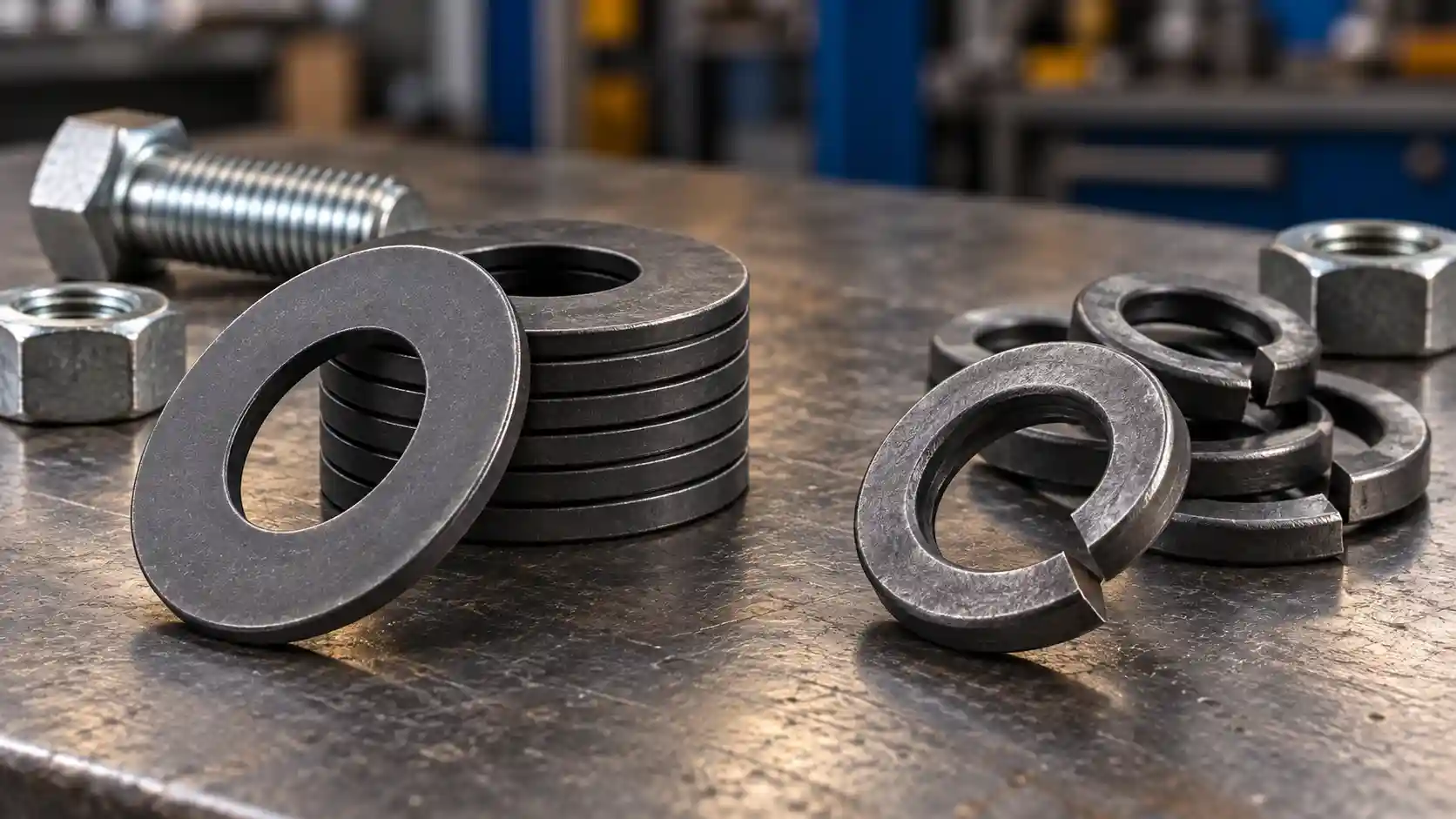
A Plain Washer is pretty straightforward; it consists of nothing but a circular piece of metal that has a hole in its middle, big enough to fit over a fastener. The washer distributes the pressure of the nut or bolt evenly while preventing the mating surface from wearing. There's no spring action here and no biting edge — just a washer built for even, dependable contact, found in every industrial plain washer EASCO supplies.
|
TRIVIA: “The word "washer" likely traces back to an old term for a metal ring or plate used in fastening work — not to washing or cleaning at all, despite how it sounds.” |
Common Applications of Plain Washers
These qualities make plain washers a fit across a wide range of settings.
- General machinery assembly, where surface protection matters most
- Automotive builds use them under bolt heads to prevent surface marring
- Construction fastening leans on them to spread load across soft materials
- Ask yourself: does the joint need locking, or just protection? plain washer applications like these usually call for the latter
What Is a Spring Lock Washer?
Now compare that with a washer built for a different job entirely.
A spring lock washer takes a split-ring, helical shape instead of a flat disc. That coil design lets it flex under pressure and apply light spring tension against the fastener — a feature traditionally used in assemblies exposed to vibration. Cut and slightly twisted along one edge, the design creates a bite that pushes back against the nut or bolt face. It's a spring washer built for movement-prone joints, not static surface protection.
|
DID YOU KNOW? “Spring lock washers were widely adopted decades ago specifically for machinery exposed to constant motion, long before many of today's modern locking fastener designs existed.” |
Common Applications of Spring Lock Washers
Suitability always comes back to the joint itself.
- Machinery running under regular vibration or cyclic loading
- Equipment that's maintained and re-tightened on a recurring schedule
- Engineering fastening where the joint design calls for extra resistance to loosening
- Not every vibrating joint needs one — check the design first, since spring lock washer applications depend heavily on joint geometry
Plain Washer vs Spring Lock Washer: Key Differences
Side by side, the differences become easy to see.
Construction differs first — one is flat, one is coiled. Function differs next: one protects and distributes, the other resists loosening. Load distribution favours the plain washer, since its full flat surface spreads pressure evenly, while the spring lock washer's split design reduces that even contact. Surface interaction splits the two as well — flat washers sit smooth against a surface, while lock washers can bite or mark it slightly.
This plain washer vs. spring lock washer comparison is usually where selection decisions start.
| Feature | Plain Washer | Spring Lock Washer |
|---|---|---|
| Shape | Flat, solid disc | Split, helical coil |
| Primary Function | Load distribution, surface protection | Provides limited spring action |
| Surface Contact | Full, even contact | Partial, angled contact |
| Best Suited For | Load distribution and surface protection | Assemblies where the joint specification calls for one |
| Locking Ability | None | Limited; do not rely on it to prevent vibration loosening |
How to Choose Between Plain and Spring Lock Washers
With the differences clear, here's how to actually decide.
Selection isn't about which washer performs "better" overall. It's about matching washer behaviour to what the joint actually needs. Four factors should guide that decision every time, and each one is covered below as part of a working washer selection guide.
Consider the Fastening Application
Start with the basics of the joint itself.
- Does the joint need surface protection, or resistance to loosening?
- Static assemblies usually call for a plain washer
- Movement-prone joints often lean toward a spring lock washer
Evaluate Load and Vibration Conditions
Movement changes the calculation significantly.
- Constant vibration tips the scales toward locking support
- Heavy static loads spread more evenly under simple, flat contact
- If a joint seemed secure at installation but loosens over time, cyclic loading is often why
Check Material and Environmental Conditions
Environment matters just as much as load, sometimes more.
- Corrosion-prone settings need washer material matched to resist it, not just tolerate it
- Spring steel loses some of its snap under extreme temperature swings
- Washdown areas and outdoor exposure call for material that won't degrade under constant moisture
Match Washer Size with the Fastener
None of this matters if the fit itself is wrong.
- Start with inside diameter — it has to match the fastener shank exactly
- Outside diameter needs to clear the mating surface and hole properly
- Thickness isn't cosmetic; it carries real load-bearing weight, so double-check washer sizes against the bolt spec before ordering
|
FACT: “A washer's outside diameter, not just its inside diameter, directly affects how evenly clamping force spreads across the mating surface.” |
What to Look for in Reliable Washers Manufacturers
Picking the right washer type only gets you halfway there — the supplier behind it matters too.
- Batch-to-batch dimensional consistency, not just a matching sample piece
- Material quality you can verify — spec-sheet claims aren't proof
- Manufacturing lines that handle plain and spring lock washer types without switching vendors
- Standards and specifications compliance, checked rather than assumed
- Surface finish that stays clean and consistent across the whole order
- Quality control documented at every stage, start to finish
- Trusted washer suppliers covering more than one washer need under one roof
- Bulk orders handled without compromised consistency
That's the standard EASCO builds around: consistent dimensions, verified materials, and the manufacturing range to deliver both washer types without compromise. Whether you're sourcing from Washers Manufacturers in India for a single project or an ongoing supply line, the process stays consistent throughout.
Choose the Right Washer for Reliable Fastening
Bring it back to the decision in front of you.
Getting this choice right protects both your joint and your reputation for reliable assembly work. A Plain Washer handles surface protection and load spread. A spring lock washer adds resistance against loosening in the right conditions. Match the washer to the application, not the other way around.
When you're ready to source either type, EASCO manufactures both to consistent, dependable standards — reach out to talk through your requirements and get exactly what your assembly needs.
Construction, mainly. A plain washer is a flat disc that spreads load and protects surfaces. A spring lock washer coils into a split ring built to resist loosening under vibration. Pick based on what the joint actually faces — steady pressure or constant movement — rather than habit or guesswork.
No. Spring lock washers trade full, even surface contact for locking resistance, which isn't ideal where surface protection matters most. Static assemblies on soft materials usually still call for a plain washer instead, since even load distribution protects the mating surface far better over the long run.
Fit comes down to three measurements: how the inside diameter matches your fastener shank, how the outside diameter clears your mating surface and hole, and how much load the thickness can carry. Skip any one of these and fit suffers. Confirm exact washer sizes against the bolt spec sheet before a bulk order goes out.
It does, and by a wide margin. The wrong washer material in a corrosive or outdoor setting tends to wear out fast, lose clamping strength, and let the joint fail well ahead of the fastener itself. Match material to the environment before anything else.
Joints don't all face the same conditions. EASCO carries both washer types so buyers can match load, vibration and surface needs without hunting for a second supplier. Verified material quality and consistent dimensions across both lines keep results predictable, order after order.
Start with dimensional consistency and verified material quality — claims on a page don't count for much on their own. A dependable name among washer manufacturers backs that up with documented quality control and a product range wide enough to cover more than one need. EASCO checks each box.