

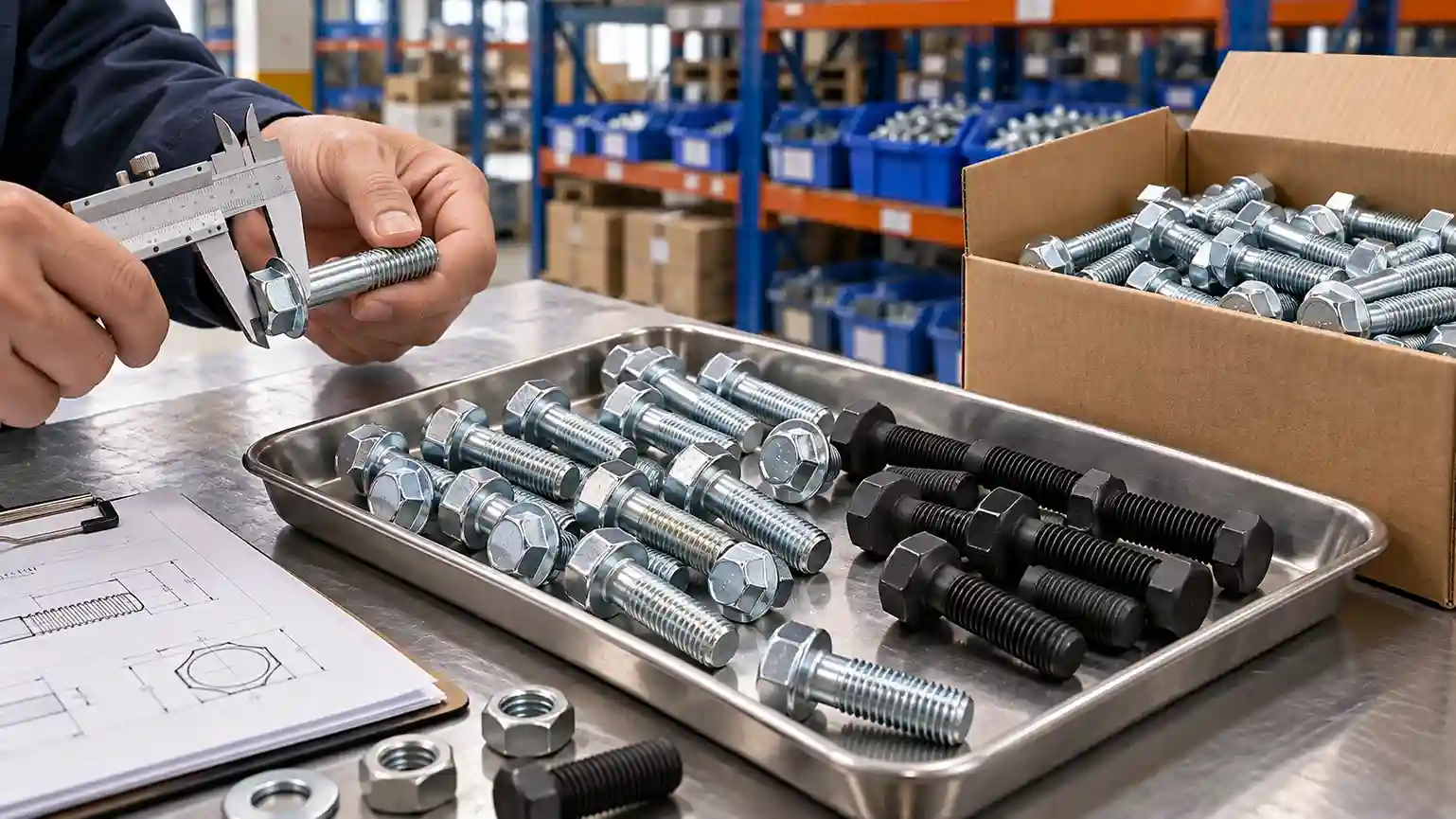
- Define Your Bolt Requirements Before Contacting Suppliers
- Check the Supplier’s Product Range and Technical Support
- Evaluate Bolt Quality, Inspection and Traceability
- Compare Bulk Prices Beyond the Unit Cost
- Approve Samples Before Placing a Bulk Order
- Request a Specification-Based Quote from EASCO
- Conclusion
The choice of an adequate supplier of bolts is a very important decision taken by industrial customers, since they need to maintain quality, specification and proper delivery. Even a small mistake in measurement, thread requirement or material used can cause problems while assembling the bolts, and thus delay the process with added costs of industrial bolts.
A trusted supplier must go beyond offering competitive quotations. Before making a big order, buyers ought to consider product suitability, inspection processes, capability of supply, and communication as well. A systematic selection process will help the businesses to minimize the purchasing risks as well as establish a reliable supply relationship with EASCO.
Define Your Bolt Requirements Before Contacting Suppliers
A well-defined specification of the fasteners your application needs should be developed before visiting bolts manufacturers or distributors. This simplifies the process of comparison of the quotation and minimizes the chances of getting products that are not suitable to your technical requirements.
Record the following information:
- Bolt type: Decide on the kind of bolts to use: hex bolts, serrated flange bolts, etc.
- Dimension: State diameter, length of threads, etc.
- Material and grade: State the needed material and mechanical strength grade basing on the application.
- Surface finish: Provide necessary surface coating or finishing, considering corrosion exposure and operating conditions.
- Quantity ordered: Check total quantity as well as whether this will come in one shipment or in shipments as planned.
- Applicable standards: Incorporate the applicable drawing, technical specification or industry standard wherever applicable.
- Delivery specification: Give the destination and date of delivery.
A full specification assists the suppliers in offering correct quotes and it also enables your purchasing department to level the playing field in comparison with the offers.
Check the Supplier’s Product Range and Technical Support
The product range by a supplier must be equivalent to your actual application needs. Some customers require standard fasteners to carry out their usual repair, but others might need special sizes, thread forms or finishes on the industrial fastener.
While assessing prospective suppliers of fasteners within the industry, the following aspects should be considered:
- Products available: It should be assessed whether the supplier has the capacity to provide us with the required type of bolts.
- Technical Clarification: We should make sure that we can clarify issues regarding dimensions, grades, finishes, etc. before placing our orders.
- Product documentation: Requests to provide any technical details and documentation where needed.
- Flexibility of order: Negotiate with the supplier on whether he can meet your desired quantity and repetition order schedule.
An example is hex head bolts are typical, used in machinery, equipment assembly, and structural applications, the serrated flange bolts may be useful in preventing loosening in the appropriate conditions of installation. Their applicability is still subject to the design of the joint, the environment in which they operate, and the specifications given by their manufacturers.
EASCO may be taken into account when evaluating your supplier, comparing the available information about its products and ensuring that the offering corresponds to the needs that you have.
Evaluate Bolt Quality, Inspection and Traceability
Quality of product must be evaluated then price is not the determining factor. In bulk buying, non-conformable dimensions, wrong grades or inappropriate finishes can influence the installation, joint performance, and production schedules.
Inquire about inspection and quality-control measures of a supplier before accepting it. An actual assessment ought to encompass:
- Sample inspection: Compare the representative samples with the approved drawing and specification.
- Dimensional check: Verify significant measurements, thread details and tolerances.
- Grade check: Reorder appropriate documentation to check the stated material and mechanical properties.
- Relevant standards: Determine the relevant standards on product, and is compliance documentation present.
- Batch identification: Determine whether batches provided can be traced with the help of the necessary identification or production records.
- Inspection documents: Requests When required by the purchase specification, request the test certificates or inspection reports of the requested material.
| Did You Know? “Bolts of a similar size can vary in mechanical properties due to variation in material, manufacturing or strength grade.” |
Before an order is placed to the bolt manufacturers in India for the bolts, buyers in India need to write acceptance criteria. Well defined requirements ensure that inspection is more objective and can end quality conflicts in case a customer accepts a batch that is not delivered in accordance to the agreed specification.
Compare Bulk Prices Beyond the Unit Cost
Quotation at the lowest does not necessarily translate to the most appropriate purchasing decision. The right comparison takes into account the total cost of acquiring, obtaining, checking and consuming the bolts.
In making a review of quotations on bulk bolts or wholesale bolts, compare the following:
- Unit price: Check that all the suppliers are offering the same type, dimension, grade, and finish.
- Minimum order quantity: Determine whether the required order quantity is in line with the conditions of the supplier with regard to ordering.
- Taxes and freight: Include any tax, and transportation as well as handling costs on the comparison.
- Packaging: check the packaging to ensure that the fasteners are not damaged during storage and transportation.
- Payment terms: Verbally certify the suggested payment plan and other terms of business.
- Costs related to quality: Have in mind inspection costs, batches rejected, and replacement delays, and interruptions in production.
|
Trivia: “The difference in the quoted price per bolt is small, but when multiplied over thousands can have a big impact.” |
Ask them to provide similar written quotes rather than using the price on the headline. This technique helps the purchasing team identify the actual variations in cost and select the supplier who is both cost-effective and reliable in terms of performance and deliveries.
Verify Supply Capacity and Delivery Reliability
The supplier must be able to deliver the agreed volume within the agreed period. Bolts manufactured correctly can still pose operational issues when they come after a production production cycle or maintenance break.
Ensure that before settling on a supplier, they have the following practical arrangements:
- Stock availability: Inquire about what products are in stock and what ones need to be made or ordered.
- Lead time: Get a feasible dispatch and delivery schedule.
- Order capacity: Check on the capacity of the supplier to supply the full amount.
- Planned deliveries: Talk about partial consignments in case your business needs a case of staggered deliveries so that your operations are not interrupted.
- Packaging and dispatch: Agree on how the products are to be represented in terms of identification, packing and safety during the transportation process.
- Repeat-order support: Determine whether the supplier is capable of production based on approved specifications in the future.
In the case of continuous industrial needs, a constant communication is equally important as the speed of delivery. Enter purchase order dates and quantities that are agreed, and how delays or shortages are going to be reported.
Approve Samples Before Placing a Bulk Order
The sample approval proves to be a useful protective measure in cases of buying a new bolt specification or a new supplier. It also enables your technical and purchasing departments to recognize possible issues and not make any big commitments such as entering into a big consignment.
Consistently use an approval process:
- Compare sample and approved drawing and purchase specification.
- Check dimensions including thread fit, material documentation and surface finish as necessary.
- Ensure that it is suitable to be used in the assembly desired by using the relevant technical checks.
- Document the accepted specification and, where feasible, maintain a reference sample.
- In the purchase order, include acceptance criteria and inspection requirements.
- Explain how nonconforming products, shortages and substitutes will be done.
Request a Specification-Based Quote from EASCO
After defining what you need, call EASCO to make queries about the applicable bolt products. Give the supplier sufficient information so that he can make a good evaluation of your request.
Before submitting your enquiry, prepare the following details:
- Type of bolt and what is it to be used.
- Diameter, length, pitch of the thread and standard to be used.
- Surface finish, material, and grade of strength.
- Ordering frequency and quantity expected.
- Delivery place and delivery schedule.
- Illustrations, technical specification or inspection conditions, as appropriate.
Ask for a quotation in writing that clearly states the specification quoted, the quantity, delivery, and terms of business.
Conclusion
A correct selection of bolts supplier cannot be made based on quotations only. Prior to making a bulk purchase for a product, one should take into account the specification of a product, the quality evidence, the inspection process, the ability to supply, and the certainty of delivery.
Avoiding problems: Certain purchase specifications, approved samples and acceptance criteria may be employed to avoid unnecessary problems and achieve a consistent procurement process. Industrial purchasers will be able to make correct purchasing decisions and build more lasting sourcing relationships by considering such things and discussing their requirements with a potential supplier, such as EASCO.
| Need a reliable bolts supplier, in bulk, for your industry? Contact EASCO and discuss your bolt requirements to obtain an appropriate fastener solution for your industry. |
Add the type of bolt, diameter, length, thread pitch, material, grade of strength, surface finishing, and quantity, and standard. Includes drawings or technical requirements where required, delivery place and date required. Full disclosure assists suppliers in making correct quotations and minimizes the chances of misalignments in specifications.
Take sample requests, check critical dimensions and confirm the specified grade with the appropriate documentation. Request material test certificates, inspection reports or evidence of the conformity to the applicable standard depending on the application. The batch identification and agreed incoming inspection criteria are also useful in creating accountability in terms of bulk deliveries.
The proper one will depend on quantity, availability, technical aspects, and delivery times. Manufacturers will be able to help in the production of proper orders while distributors will be able to give access to ready stock. Look at what capabilities, documents, costs, and delivery promises each has instead of thinking that one source of supply is better than the other.
Prices of bulk bolts are based on the material, size, grade of strength, surface, quantity ordered, standards and testing needs. The ultimate cost of purchase can also be influenced by packaging, transportation, taxes and the payment terms. Compare written quotes of the same specifications to determine meaningful price differences and to prevent a false comparison.
Sample approval assists in determining dimensional variations, thread matching problems, inappropriate finishes and documentation shortfalls prior to placing a large order. It enables the technical department to verify that the suggested fastener is as per the requirements. Approval criteria should be documented by buyers and appropriate reference records maintained to allow later batch inspection.
Check to confirm the expected date of dispatch, date of delivery, quantity, packaging and how to deliver partial consignments. Questions to ask are how shortages, damaged goods, or specification deviations should be reported and what the replacement procedure is. Document the agreed process and schedules so that the two parties are aware of their duties in case of an issue of delivery.