

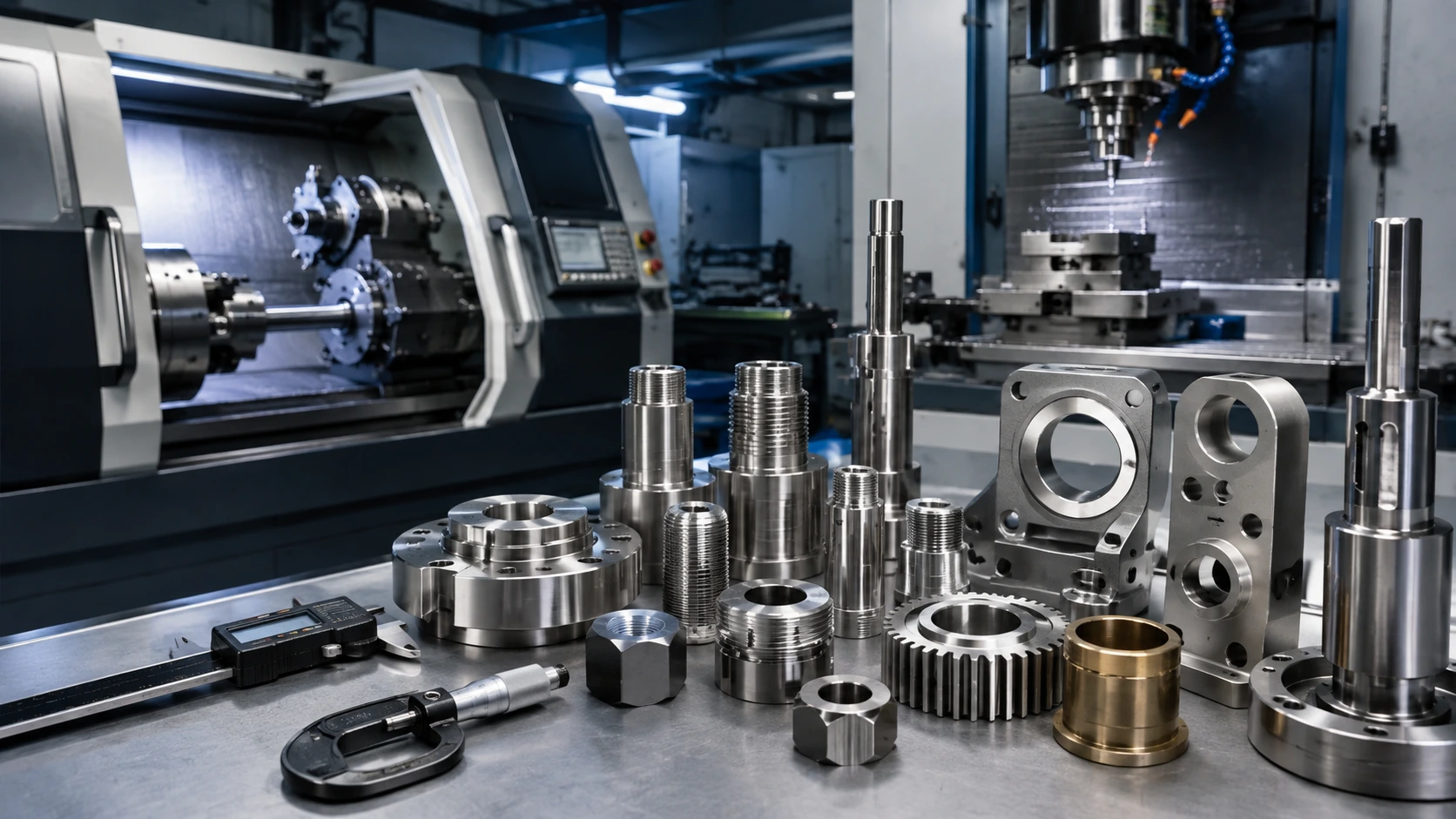
- What Are CNC Machined Components?
- Why Is It Important?
- Types of CNC Machined Components
- Features to Look For
- Product Overview
- Benefits
- Applications and Use Cases
- Comparison: Common CNC Processes at a Glance
- Expert Tips and Buying Guide
- About EASCO Fasteners
- Conclusion
Everything procurement teams and design engineers need to know before sourcing precision parts from a CNC machining company.
Ask any production engineer what keeps them up at night and fitment is usually on the list — will this shaft actually sit inside that housing the way it did on the drawing? CNC Machined Components answer that question, over and over. A machine reads a program instead of a person reading a dial, so the part made at 4 pm looks the same as the one made at 9 am. For a buyer sitting across the table from a new supplier, the real work is checking whether their process holds up to that promise. This piece covers how the parts are made and what to ask before you sign off on a CNC Component Manufacturer.
What Are CNC Machined Components?
CNC simply means Computer Numerical Control — instructions written once and repeated by the machine without a person nudging the tool by hand. A CAD drawing becomes code, and from there CNC Machined Parts are cut, drilled or shaped straight out of a solid block of metal or plastic. Do the same job by hand a hundred times and you'll get a hundred slightly different results; run it through a CNC program and part ninety-nine looks like part one. That consistency is why Precision Machined Parts show up wherever a stray fraction of a millimetre isn't a rounding error, it's a rejected part — small pins, large brackets, threaded housings alike.
Why Is It Important?
A shaft that's a hair off-centre doesn't announce itself right away — it shows up later as noise, wear, or a part that seizes months into service. That's the quiet reason CNC Machining Services matter so much to automotive lines, aerospace assemblies, medical devices and factory automation. Order ten pieces or order ten thousand, the process doesn't drift the way manual work sometimes does, and less ends up as scrap along the way.
| Did You Know? A tolerance of ±0.005 mm is finer than a human hair — and a well-set CNC program can hold that number for thousands of parts in a row. |
Types of CNC Machined Components
The shape you need usually decides the process, not the other way round:
- CNC Milling Components – a rotating cutter leaves flat faces, slots and 3D contours; brackets, housings, mounting plates.
- CNC Turning Components – the part spins while a fixed tool shapes it, so turning owns anything round: shafts, pins, bushings, threaded stems.
- Drilled and tapped parts – holes that line up exactly, threads that grip instead of stripping.
- Turn-mill work – turning and milling on one setup, no re-fixturing halfway through.
- Swiss-machined parts – the small, precise stuff found inside connectors and medical devices.
- EDM – controlled sparks instead of a cutting edge, for materials too hard for a regular tool.
Features to Look For
Price is the easy comparison. The harder, more useful questions are these:
- What tolerance can they actually hold on a repeat basis? ±0.005 mm for the tight jobs is a fair benchmark.
- Which materials are they set up for — stainless, aluminium, brass, alloy steel, engineering plastics?
- What surface finish range do they offer, from a fine Ra 0.8 µm to a standard functional finish?
- Do they offer plating — zinc, anodising, black oxide — for parts in corrosive environments?
- Is there an actual inspection step with calibrated gauges, or is it checked by eye?
- Can the same line handle a five-piece prototype run as easily as five thousand?
Product Overview
A question we hear often: where does a buyer actually get all of this reliably? A solid CNC Machining Company doesn't just do one part type — it runs shafts, housings, brackets, bushings and threaded components alongside the everyday hardware that pairs with them: nuts, bolts, washers, circlips, dowel pins. Keeping it under one roof stops specifications from drifting between vendors. A single CNC Parts Manufacturer handling the whole basket also means fewer inspection reports to reconcile and usually a shorter path from order to dispatch.
Benefits
The upside of working with a proper CNC Precision Components supplier isn't only the part itself:
- batches stay dimensionally consistent, so the rejection pile at assembly gets smaller
- turnaround holds up whether it's a one-off prototype or a repeat run
- less raw material ends up as scrap compared with manual cutting
- the same line usually switches between metals and plastics without much fuss
- odd part geometries get real design support instead of a flat refusal
- results don't depend on which operator was on shift that day
Applications and Use Cases
High Precision Machined Components turn up in more places than most people expect once you start looking:
- Automotive – engine, transmission and suspension parts that take constant vibration without loosening early.
- Aerospace – landing gear elements, engine mounts, structural brackets, all needing full traceability.
- Medical and healthcare – surgical instruments, implants, device housings, where the material has to be biocompatible.
- Electronics – connector bodies, heat sinks, and the tiny internal parts Swiss machining handles well.
- Industrial machinery – gear assemblies, custom tooling, and the sub-assemblies keeping automation lines running.
| Trivia Long before CAD software existed, the first numerically controlled machines in the 1940s ran on punched paper tape. |
Comparison: Common CNC Processes at a Glance
Understand the common CNC processes through the following table:
| Process | Best Suited For | Typical Output |
|---|---|---|
| CNC Milling | Flat, multi-surface, or complex 3D shapes | Brackets, housings, plates |
| CNC Turning | Round, symmetrical components | Shafts, bushings, pins |
| Drilling & Tapping | Holes and internal threads | Mounting points, assembly holes |
| Turn-Mill | Parts needing combined operations | Complex multi-feature components |
| Swiss Machining | Very small, intricate parts | Medical and electronic components |
| EDM | Hard materials, fine cavities | Tooling inserts, detailed dies |
Expert Tips and Buying Guide
A few things that save people trouble later, from suppliers of Precision Engineering Components who've seen orders go sideways:
- send the full CAD or DXF file upfront with material, tolerance and finish spelled out
- ask for a first article sample before the full batch runs, not after
- check whether volume orders need re-tooling, or scale without extra delay
- ISO 9001 is a reasonable proxy for whether the quality process is actually documented
- get realistic on lead time early; tight tolerances and awkward geometry both push it out
- decide on plating or coating at the design stage, not after the part is already cut
| Fact Stainless steel and titanium show up in medical-grade parts mainly for one reason — the body tolerates them, and they don't corrode inside it. |
About EASCO Fasteners
Easco Fasteners is a trusted name among contractors and procurement professionals seeking high-quality fasteners and best-engineered components. Easco Fasteners Pvt Ltd, since 1968, has been delivering precisely for more than 55 years. With a comprehensive product range and a commitment to consistency, Easco provides solutions that hold up under real-world conditions — literally and figuratively. If you are looking for fasteners, circlips, dowel pins, nuts, washers, bolts and other products, we are perfect for you. Easco also provides high-quality CNC-machined components and screws to meet the diverse demands of modern construction and manufacturing.
Conclusion
At the end of it, CNC machining earns its place because it does the boring thing well — the same part, correct, every single time. Single prototype or a production run in the thousands, what matters is finding a CNC Component Manufacturer who treats tolerances and material choice as non-negotiable. For a buyer, that's the real decision: not who quotes fastest, but who documents properly and answers the phone when a drawing needs a second look.
| Have a drawing that needs to become a real part? Get in touch with EASCO Fasteners and let's talk tolerances, materials, and timelines. Contact Us Now! |
Basically, if a machine cut it from a program instead of a person guiding a tool by hand, it's CNC machined. The file tells the machine where to cut, drill, or shape the material. Shafts, brackets, housings — all of it comes out the same way, piece after piece, without drifting.
Metals mostly — stainless steel, aluminium, brass, alloy steel, mild steel. Plastics too, ABS and PTFE and nylon show up often enough. What decides the pick isn't really the machine, it's the job. Something outdoors needs corrosion resistance; something load-bearing needs strength over weight. The material follows the application, not the other way round.
Depends who you ask and what they're making. Everyday parts sit somewhere around ±0.02 mm to ±0.10 mm. Push into critical work and ±0.005 mm isn't unusual either. Geometry plays into it, so does the material — a thin wall behaves differently under a cutter than a solid block does. Worth asking your supplier directly.
In milling, the part stays still and a spinning cutter moves around it — good for flat faces, pockets, odd 3D shapes. Turning flips that: the part spins, the tool stays put. That's why anything round — shafts, pins, bushings — usually gets turned rather than milled. Shape decides the process more than anything else.
Usually, yes. A decent setup runs five prototype pieces the same way it'll run five thousand later — same program, same tooling logic, nothing gets rebuilt from scratch between the two. That's actually the point of testing a prototype first: catch problems early, then scale without surprises showing up mid-production.
Not every part does. Some sit fine bare metal, no issue. Others — anything outdoors, anything near moisture — do better with zinc plating, anodising, or black oxide added on. The smarter move is deciding this while the design's still on paper, not after the part's already been cut and finished.