

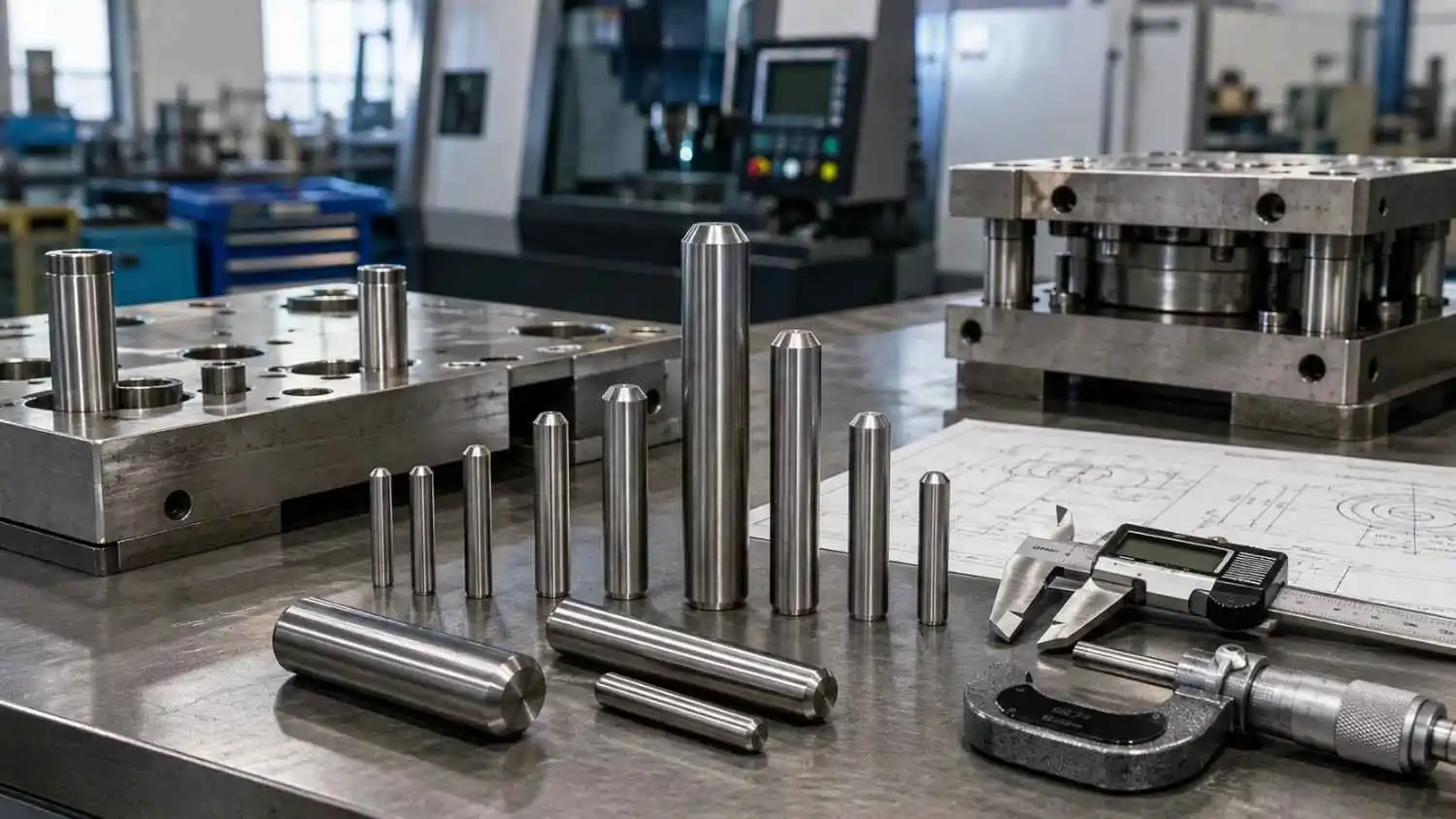
- What Are Dowel Pins?
- Why Do They Matter So Much?
- Types and Variants
- Features to Look For
- Product Overview
- Benefits
- Applications and Use Cases
- Comparison at a Glance
- Expert Tips and Buying Guide
- About EASCO Fasteners
- Conclusion
What actually matters when you're specifying dowel pins for jigs, fixtures, and precision tooling
Every assembly line has that one component nobody thinks about until it fails. Dowel Pins are exactly that kind of unsung hero. Small, cylindrical, unglamorous — and critical the moment two parts need to sit in exact position relative to each other. Skip a properly specified Dowel Pin, and tolerances drift. Holes misalign. This guide walks through what these pins actually do, which type suits which job, and how to specify Hardened Dowel Pins without second-guessing yourself on the shop floor. Whether you're sourcing for a die set or a line that cannot afford misalignment, the fundamentals here save rework later.
What Are Dowel Pins?
Dowel Pins are short, solid rods. Cylindrical, precise, nothing fancy about them. Their job is to hold two or more mating parts in the exact same position, every time. Bolts and screws work through tension. Dowel pins don't — they just sit there and keep things aligned, cycle after cycle, without drifting.
A standard Dowel Pin is machined to a tight tolerance, ground rather than turned, so it slips into a reamed hole with barely any play. Some carry alternate names — locating pins, positioning pins, tooling pins — but the function stays identical.
- They resist shear forces far better than most general-purpose fasteners
- They're reusable across thousands of assembly and disassembly cycles
- They come in parallel, taper, and grooved forms, each suited to a different fit
- They rarely feature on a highlight reel, but they decide whether the rest of the drawing actually works
Why Do They Matter So Much?
Ask anyone who runs a tool room what usually goes wrong first. Nine times out of ten, it's a worn pin, or the wrong one fitted in the first place. Alignment Dowel Pins carry the entire burden of positional accuracy in jigs, molds, and die sets. Get the fit wrong — too loose, too tight, or the wrong hardness for the duty cycle — and the whole downstream process pays for it in scrap, rework, and lost time.
- Prevent lateral movement between mating components under load
- Maintain consistent hole-to-hole spacing across thousands of repeated cycles
- Reduce wear on surrounding bores compared with unhardened or soft alternatives
- Simplify disassembly and reassembly during scheduled maintenance
- Support tight-tolerance work across aerospace, automotive, and mold-making
Types and Variants
Not every job needs the same pin. Pick the wrong one, and it shows up later — usually at the worst time. Here's the breakdown, roughly by use case:
- Parallel or Straight Dowel Pins — the default choice for general alignment work across most jigs
- Hardened Steel Dowel Pins — heat-treated for high-wear, high-cycle applications such as die sets and stamping tools
- Taper Dowel Pins — self-locking geometry, useful where periodic removal and refitting is routine
- Grooved Dowel Pins — knurled or grooved surface for extra grip in softer or plastic materials
- Spring or Coiled Dowel Pins — flexible, shock-absorbing, forgiving of minor bore variance
- Solid Dowel Pins — one-piece, non-hollow construction built for maximum load-bearing strength
Not sure which one your drawing actually calls for? Nine times out of ten, that's a hardness and tolerance question before it's ever a shape question.
Features to Look For
Buying a pin sounds simple until you're staring at a spec sheet with overlapping tolerance grades and no clear starting point. A handful of features genuinely matter:
- Hardness rating — case-hardened or through-hardened, chosen against expected wear exposure
- Surface finish — a ground finish cuts insertion friction and reduces bore wear over time
- Diameter tolerance — mismatched tolerance grades are the single biggest cause of loose or seized fits
- Chamfer geometry — a proper lead-in chamfer saves time and knuckles during manual insertion
- Material grade — alloy steel covers most industrial work; stainless steps in where corrosion is a concern
Precision Ground Dowel Pins are worth the small premium wherever repeatability genuinely matters — mold tooling, gauge fixtures, and anything measured in microns rather than millimetres.
| FACT: A correctly fitted hardened dowel pin can, in many applications, outlast the fixture it's installed in. |
Product Overview
This is where sourcing gets practical. Steel dowel pins, machine dowel pins, and locating dowel pins — together they cover most of the industrial demand out there. Jig fixtures, mold bases, routine assembly work, all of it. EASCO Fasteners makes precision-engineered dowel pins across these categories. Tolerance and hardness stay controlled, batch after batch, so performance doesn't wobble even on high-volume runs. Need a case-hardened pin for a die set? Or maybe a Precision Dowel Pins batch for gauge tooling? Either way, working with a manufacturer that controls both material and grinding process cuts out most of the guesswork before procurement even starts.
Benefits
Short version: fewer headaches downstream, and fewer late-night calls from the shop floor.
- Consistent, repeatable positioning across thousands of cycles
- Reduced bore wear compared with soft or unhardened pins
- Better load distribution under shear stress
- Lower long-term maintenance cost across jigs and fixtures
- Simplifies quality control — parts either fit correctly, or they don't
Applications and Use Cases
Dowel Pins show up everywhere precision matters more than raw speed:
- Jigs and fixtures on high-volume assembly lines
- Injection mold bases and die sets
- CNC machining fixtures and workholding setups
- Automotive component alignment and body-panel tooling
- Aerospace tooling, gauge blocks, and inspection fixtures
- Electrical enclosure and control-panel assembly
| DID YOU KNOW? Die-casting shops often pack dozens of dowel pins into a single cavity plate. Each one has to hold its spot within a few microns — no exceptions. |
Comparison at a Glance
A quick, general comparison across common pin types — useful as a starting reference, not a substitute for your drawing's tolerance callouts.
| Pin Type | Typical Hardness | Best Suited For | Reusability |
|---|---|---|---|
| Parallel / Straight | Medium to high | General alignment, routine assembly | High |
| Hardened Steel | High, case or through-hardened | Die sets, high-cycle production tooling | Very high |
| Taper | Medium to high | Fixtures needing frequent removal | High |
| Grooved | Medium | Softer materials, plastic housings | Moderate |
| Spring / Coiled | Medium, flexible | Shock-prone or vibration-heavy assemblies | High |
| Solid | High | Heavy load-bearing alignment | Very high |
Expert Tips and Buying Guide
Before finalizing a purchase order, run through this checklist:
- Confirm the bore tolerance you're pinning into — don't estimate it, measure it
- Match hardness to expected cycle count, not just to current budget constraints
- Choose a ground finish over a turned finish for any repeat-use fixture
- Ask for material certification whenever the application is safety- or tolerance-critical
- Keep spares on hand — pins tend to wear faster than the fixtures they align
| TRIVIA: The word "dowel" traces back to old carpentry practice, long before precision-ground steel pins ever existed. |
Working with a dependable network of Dowel Pin Manufacturers in India means fewer delays when a line suddenly needs an urgent replacement batch. Consistency of supply matters as much as consistency of the part itself.
About EASCO Fasteners
Easco is a trusted name among contractors and procurement professionals seeking high-quality fasteners and best-engineered components. Easco Fasteners Pvt Ltd, since 1968, has been delivering precisely for more than 55 years. With a comprehensive product range and a commitment to consistency, Easco provides solutions that hold up under real-world conditions — literally and figuratively. If you are looking for fasteners, circlips, dowel pins, nuts, washers, bolts and other products, we are perfect for you. Easco also provides high-quality CNC-machined components and screws to meet the diverse demands of modern construction and manufacturing.
Conclusion
Dowel Pins aren't complicated parts. But get the specification wrong, and it's an expensive way to learn why they matter. Match the type to the job. Don't skimp on hardness if wear is part of the equation. And pick a manufacturer that actually treats tolerance control as non-negotiable, not a checkbox. Do that, and alignment quietly stops being your problem.
|
Need reliable dowel pins for your next production run? EASCO Fasteners supplies precision-engineered dowel pins built to hold tolerance, cycle after cycle. Contact Us Now! |
Tension. That's what a normal fastener relies on — threads, torque, clamping force. Dowel Pins skip all of that. They just drop into a reamed hole and stay put. Nothing holding them there except a snug fit. That's the whole reason jigs lean on them: position first, fastening barely matters.
Occasional use? A standard pin is fine. But run a fixture through a few thousand cycles and wear catches up fast. Hardened Steel Dowel Pins just take longer to give in. Tolerance holds up better, insertion after insertion. In a die set, that difference isn't small — it's the whole point.
Usually, yeah. That's kind of the point. A decent Solid Dowel Pins type can handle plenty of insertion cycles before it loses its fit — assuming the bore hasn't given out first. Worth a quick check for scoring or flat spots before putting it back. If it's damaged, don't push it. Replace it.
The terms get used interchangeably more often than they should. Locating Dowel Pins generally fix one part's exact position within a fixture. Alignment pins keep two components in line during assembly. Same idea, different label depending on who wrote the drawing. Check the tolerance callout either way.
Reused constantly? Go ground, no question. Precision Ground Dowel Pins hold tighter diameter tolerance and slide in with far less friction — and that adds up over thousands of cycles. Turned pins are cheaper upfront, sure. But they wear quicker and drift out of spec. Fine for a one-off job, not much else.
Material grade matters. So does the grinding process. A supplier controlling only one of those isn't enough. Reputable Dowel Pin Manufacturers in India, like EASCO Fasteners, keep hardness and tolerance consistent across every batch — which sounds minor until an inconsistent batch quietly wrecks a fixture's repeatability months later.