

- What Are Snap Rings?
- Why Do Snap Rings Matter?
- Types of Snap Rings
- What to Look For
- Product Overview
- Benefits Worth Knowing
- Where They Get Used
- About EASCO Fasteners
- Comparison at a Glance
- Buying Tips From the Field
- Conclusion
Everything engineers and buyers should know about circlips, retaining rings and choosing the right snap ring for shafts and bores
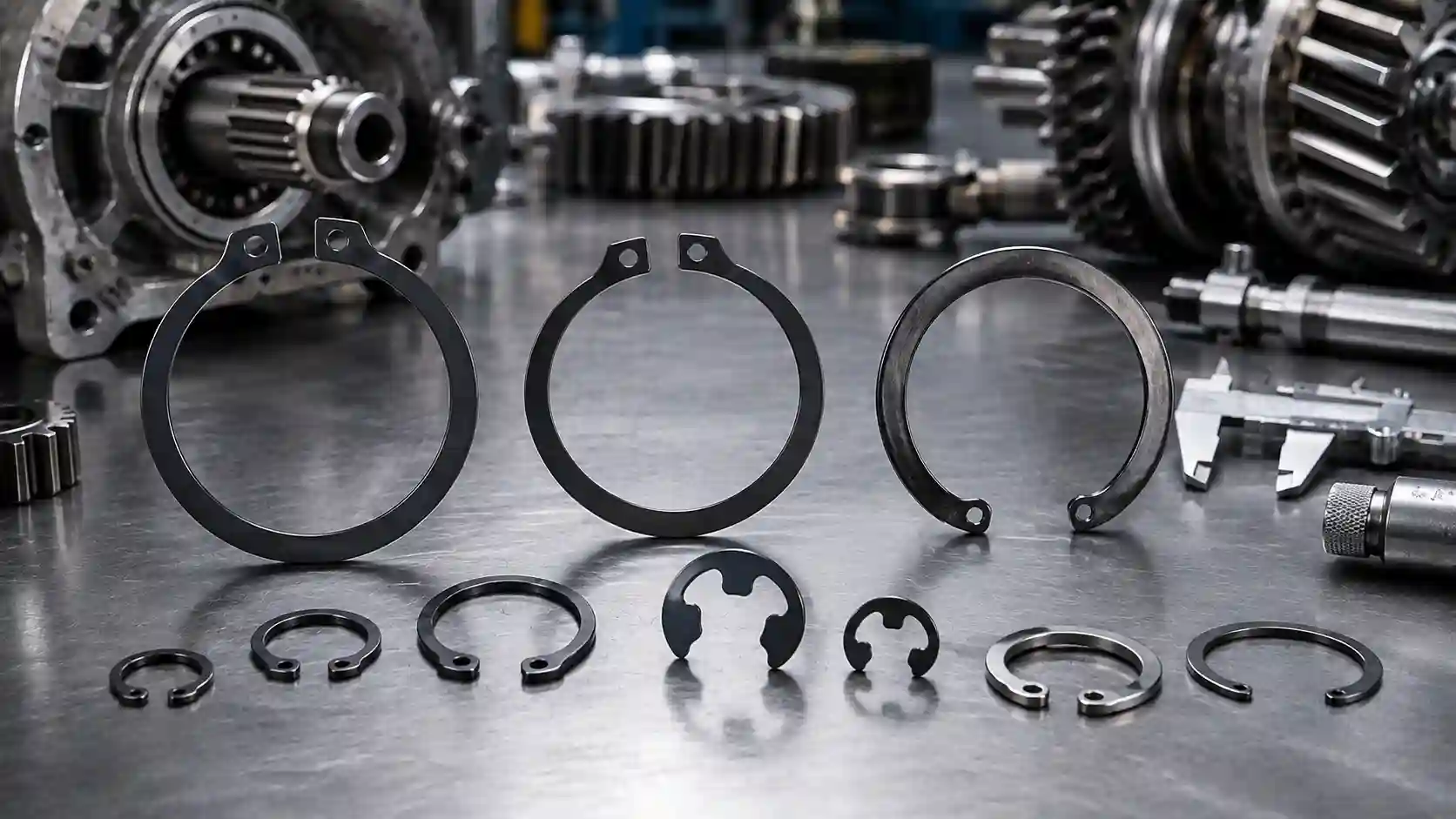
Open up almost any gearbox, motor, or bearing housing and somewhere inside you'll find a thin metal ring doing a job most people never think about. That's a snap ring. It drops into a groove and holds the bearing or gear right where it should sit, so nothing drifts sideways once the load kicks in. Simple part, but leave it out or pick the wrong size and an expensive assembly can fail within days, sometimes without much warning beforehand. This guide covers what snap rings actually are, the main types you'll come across, how they get installed, and what to look for when you're sourcing them, whether you're a design engineer or someone on the procurement side.
What Are Snap Rings?
A snap ring is a semi-flexible metal ring that fits into a machined groove cut into a shaft or inside a bore. Once it's seated, it acts like a shoulder — parts can spin, but they can't slide past it. Catalogues and drawings don't always agree on what to call it either; some say retaining ring, and in India especially, people just say circlip. Same part, different label depending on who's writing the spec sheet.
Why Do Snap Rings Matter?
Take the ring out of the equation and you need something bulkier — a threaded collar, a machined shoulder, maybe even a weld — just to keep a bearing or gear from walking off its shaft. That adds cost, adds weight, and adds machining time. A snap ring does the same job in a fraction of the space. It's also removable, which matters more than people realise until they're mid-repair and need to pull a bearing without cutting anything apart. For maintenance teams working on tight schedules, that difference alone can save hours on a single overhaul.
Types of Snap Rings
Not every ring works the same way, and picking the wrong one is a common mistake on the shop floor.
Internal Snap Rings
These fit inside a bore or housing — squeeze them down with pliers and they spring open once released, locking against the inner groove wall. You'll find internal circlips (sometimes just called bore rings) in:
- Bearing housings
- Gearbox casings
- Hydraulic cylinder bores
- Pump and motor housings
Because they sit inside the bore, engineers often refer to them as inner retaining rings on drawings.
External Snap Rings
These go the other way — around a shaft, expanded open until they snap into the shaft groove. Common places you'll see them:
- Shaft ends and steps
- Automotive drivetrain components
- Gear and pulley assemblies
- Wheel spindles and motor shafts
An external circlip usually works alongside a bearing, holding it in place against axial thrust so it doesn't shift during operation.
E-Type Circlips
E-clips are a bit different — no expanding or compressing needed. You just push them straight onto the shaft from the side, and the shape does the rest. That makes them fast on an assembly line, which is exactly why you see so many of them in automotive work and smaller mechanical builds.
What to Look For
A snap ring looks simple, but the difference between a good one and a poor one shows up fast in service:
- Good spring-back, so it snaps back to its groove diameter and stays there
- Even hardness across the ring, not just at one point
- A finish that resists corrosion — black oxide, zinc trivalent, zinc flake, or PTFE Xylan are common choices
- Dimensions that actually match DIN, IS, or ISO groove tolerances
- Smooth edges with no burrs that could chew up the groove during fitting
|
Did You Know? One snap ring can do the job of an entire locknut-and-washer setup, in a fraction of the axial space. |
Product Overview
If you're sourcing snap rings for production, you generally want one supplier who can cover internal, external, and E-type in the sizes you actually need — not three separate vendors for three ring types. EASCO Fasteners makes precision-stamped internal circlips, external circlips, and E-type circlips starting from 0.8 mm and going all the way to 400 mm, in spring steel and stainless grades like EN42J, 75C6, and SS304, built to DIN 471, DIN 472, and DIN 6799 standards. If you're weighing up snap ring suppliers in India, that kind of range tends to cover most bearing, gearbox, and shaft jobs without you having to split one order across several companies.
Benefits Worth Knowing
Some of the benefits are:
- Takes up almost no room compared to bolted or welded retention
- Installs quickly once you have the right pliers
- Holds firm under vibration and repeated load cycles
- Comes out just as easily as it goes in, which helps during servicing
- Cheaper overall than machining a shoulder into the part
Where They Get Used
You'll find snap rings almost everywhere something spins:
- Automotive — piston pins, transmission shafts, wheel bearing hubs
- Industrial machinery — pumps, compressors, motor housings, gear drives
- Agricultural equipment — shaft and bearing retention under heavy field loads
- Electrical assemblies — locating bushings and small rotating parts
- Railway and material handling gear — bearings and rollers under constant cyclic stress
The right snap ring size and grade, chosen correctly the first time, often decides how long an assembly runs before it needs opening up again.
About EASCO Fasteners
Easco is a trusted name among contractors and procurement professionals seeking high-quality fasteners and best-engineered components. Easco Fasteners Pvt Ltd, since 1968, has been delivering precisely for more than 55 years. With a comprehensive product range and a commitment to consistency, Easco provides solutions that hold up under real-world conditions — literally and figuratively. If you are looking for fasteners, circlips, dowel pins, nuts, washers, bolts and other products, we are perfect for you. Easco also provides high-quality CNC-machined components and screws to meet the diverse demands of modern construction and manufacturing.
|
Trivia The name "circlip" is simply short for "circular clip" — a term that stuck so well it's now used for almost every retaining ring shape, not just circular ones. |
Comparison at a Glance
Understand the product through the comparison table:
|
Type |
Where It Fits |
Typical Industries |
How It's Installed |
|
Internal Snap Rings |
Inside a bore or housing |
Gearboxes, hydraulics, bearing housings |
Compressed inward with internal pliers |
|
External Snap Rings |
Around a shaft groove |
Automotive, motors, pumps |
Expanded outward with external pliers |
|
E-Type Circlips |
Pressed onto shaft end |
Light engineering, automotive |
Pushed on directly, no tool expansion |
Buying Tips From the Field
Don't assume internal and external rings are swappable — they're built differently and behave differently under load. Check the actual groove diameter before you order, not the nominal shaft or bore size; even a few tenths of a millimetre off and the ring won't seat right. Go stainless if there's moisture or chemicals anywhere nearby, spring steel is plenty for a dry-running setup. Always use proper circlip pliers — forcing a ring on by hand is a fast way to bend it out of shape and shorten its life. And if you're buying in volume, working with a manufacturer that keeps consistent stock across DIN and IS sizes saves a lot of last-minute scrambling.
Conclusion
It's a small part, but skip it or size it wrong and the consequences show up quickly — a bearing that walks, a gear that shifts, a shaft that wears where it shouldn't. Getting the type, size, and finish right, and installing it properly, is what keeps the whole assembly reliable over years of use, not just weeks.
|
Talk to EASCO Fasteners for internal circlips, external circlips, and E-type circlips made to your exact groove specs. |
Honestly, nothing — it's the same part, just different regions call it differently. In India and most of Europe, people say circlip. In the US, snap ring is more common. Some catalogues even use retaining ring. Whatever the label, it's doing the exact same job inside the groove.
Sure, you can — but it's a gamble, not a guarantee. Bend a ring open or closed even once and the metal takes a bit of stress; spring-back doesn't always come back exactly right. On anything load-bearing, just spend the few rupees and use a new one. Low-stress spot? Reusing it once is probably fine.
Usually one of two things — wrong size, or a groove that's seen better days. If the spring-back doesn't line up with the groove diameter, the ring never really seats, and vibration finishes the job of loosening it. Also check the groove edges; a burr or bit of wear stops flush contact.
You could try regular pliers. Wouldn't recommend it though — good chance you scratch the shaft, chip the ring edge, or the whole thing just pings off mid-install. Circlip pliers grip those tiny end-holes properly, no bending, no drama. Cheap tool. Saves you the headache of doing the job twice.
Not really, it depends on where the ring's going. Stainless handles moisture and chemical exposure much better, so it's the obvious pick for outdoor or washdown environments. But spring steel is stronger and cheaper for dry, load-heavy applications like gearboxes. Picking stainless everywhere just adds cost without adding much benefit.
Don't measure the shaft or the bore — measure the groove, that's where people usually go wrong. Width, depth, diameter, all of it has to line up with the ring spec, or the fit's off. If you're not sure, just send your drawing to the supplier. Faster than guessing off a chart.