

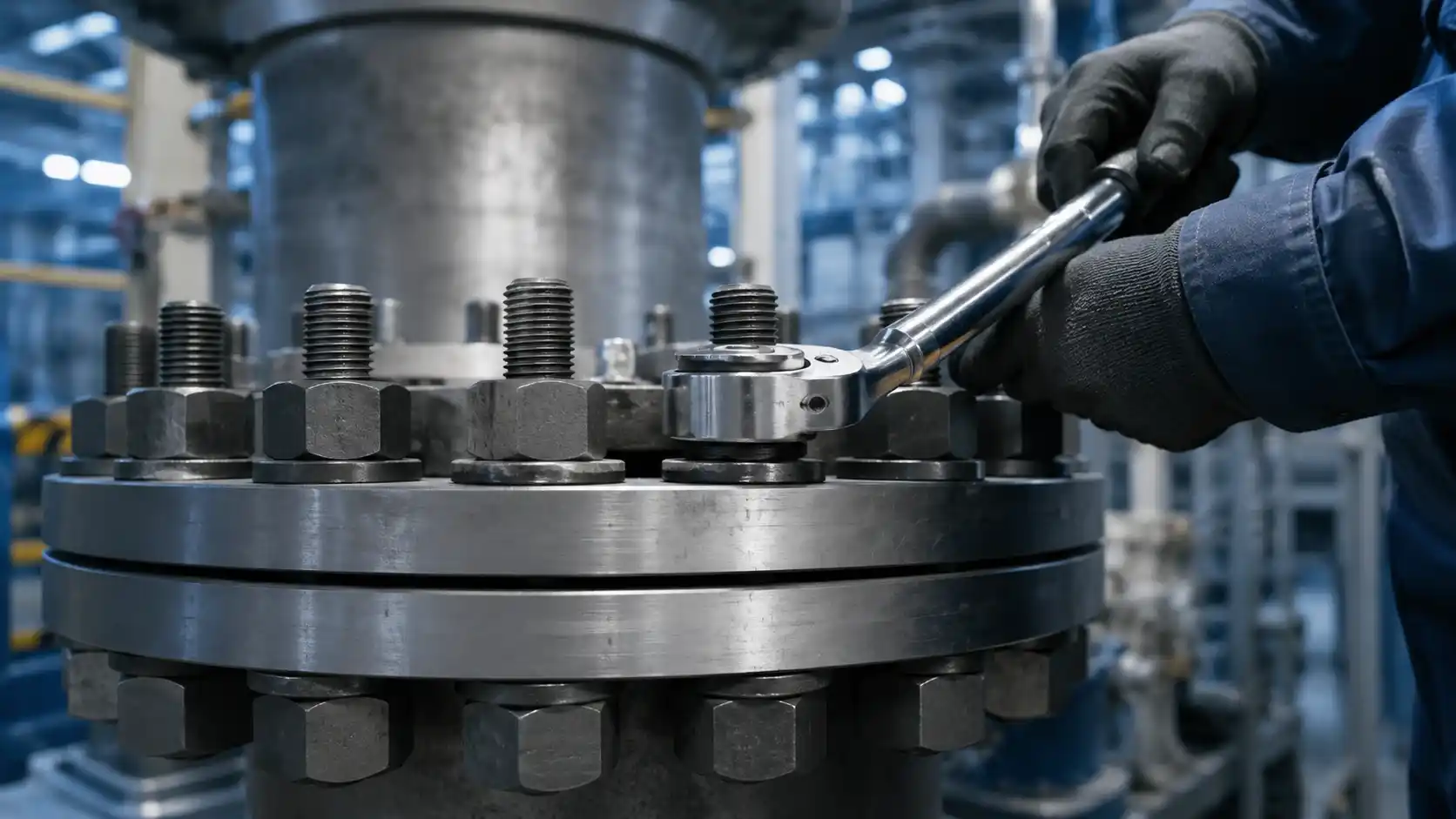
- Learning about Basic Fastener Systems
- What is Torque?
- Preload Definition
- Why Torque Isn’t Always the Same as Preload
- Bolt Tightening - The Physics Involved
- Preload Influencing Factors
- Importance of Proper Preload
- Consequences of Inappropriate Preload
- Industries Where Preloading is Important
- Advanced Tightening Techniques Employed in Industries
- Choosing High-Quality Fasteners Is Important
- Why Industries Rely on EASCO Fasteners?
- Best Practices to Attain Accurate Preload
- About EASCO Fasteners
- Conclusion
When it comes to industrial engineering, the soundness of a structure or piece of machinery may sometimes boil down to a seemingly easy thing—to tighten a fastener. From bridges to wind turbines, pipelines at oil refineries, mining machinery, pressure vessels, and industrial machines, everything depends on how one tightens a bolt. Most people think that just tightening to the required torque will result in preload; however, engineering shows a different picture. In fact, torque is only an indirect way of creating preload, and there are several factors affecting the actual clamping force created in the fastened connection.
The relation of torque and preload is very important for engineers, maintenance technicians, OEM suppliers, contractors, construction firms, and industrial buyers. Improper preload can be considered as one of the major reasons behind the failures of joints, machinery, fatigue fractures, and maintenance costs.
EASCO Fasteners is the best fastener supplier in India, which provides quality fastener products for the heavy engineering industry, construction industry, oil & gas industry, marine industry, power generation, railways, and manufacturing industries. As the most reliable Fastener Supplier, leading fastener supplier in India, and best fastener exporter in India, EASCO supplies fastener screws bolts, fastener nuts bolts screws, threaded rods, studs, washers, anchors, and industrial fasteners screws bolts.
Learning about Basic Fastener Systems
A fastener is a mechanical device used to join two or more parts. As opposed to welding and other forms of joining using adhesives, fasteners make joints which are removable and hence easy to maintain.
These industrial fasteners are:
- Hex bolts
- Heavy hex bolts
- Socket head cap screws
- Structural bolts
- Nuts
- Lock nuts
- Stud bolts
- Threaded rods
- Washers
- Anchor fasteners
- Machine screws
Despite their simple look, the performance of fasteners is highly reliant on proper tightening of the fastener. It’s not just about tightening the bolts; the aim is creating enough preload to clamp the joint together.
What is Torque?
Torque is defined as the turning force required to tighten a bolt or a screw. The measurement units for torque include Newton meter (Nm) and foot-pound (ft-lb).
Torque is applied on a bolt using a wrench and the bolt turns through the threads thereby developing tension in the bolt. But torque alone does not make the joint tight.
Torque is just a technique used to develop bolt tension.
Preload Definition
Preload is the axial tensile load induced in the bolt due to its tightening. Due to tightening, the bolt gets stretched like a spring.
Due to elastic stretching, a clamping force is developed which compresses the mating members.
Preload developed within the bolt maintains the tightness of the joint under the following conditions:
- Dynamic loading
- Vibration
- Thermal expansion
- Shock loading
- Pressure variations
- Operating conditions
Properly preloaded fastener distributes the load and ensures there is no joint movement.
If there is no proper preload in the joint, it becomes susceptible to loosening, fatigue, leakage, and other damages.
Why Torque Isn’t Always the Same as Preload
The most common misconception about fasteners is that following the proper torque guidelines will produce the right amount of preload.
This belief overlooks one basic rule of engineering,
That the majority of torque used is wasted in friction.
Only a very small part of torque actually works towards stretching the bolt.
In a standard fastener joint:
- 10% of torque goes into creating preload.
- 40% of torque is wasted in thread friction.
- 50% of torque is wasted in friction under the bolt head or nut.
So, even two identical bolts being tightened to the exact same torque may not have the same preloads because of friction.
Bolt Tightening - The Physics Involved
At the start of tightening,
The bolt starts to turn in the nut/threads.
During tightening,
Threads lock onto each other.
- Friction comes into play between mating threads.
- Friction occurs at the surface of the bolt head/nut.
- The bolt starts elongating.
- Connected material starts getting compressed.
- Stress gets stored in the bolt.
- This stress becomes a clamp load.
The bolt acts as a spring.
So long as it remains within its elastic range, it keeps trying to pull the joint apart.
Preload Influencing Factors
Some of the factors are:
1. Thread Friction
Thread friction affects the preload the most.
The small variations due to:
- Dust
- Rusting
- Manufacturing errors
- Surfaces
- Thread coatings
may result in huge differences in the final preload.
Even with the same torque applied to tighten the bolts, the difference in preloads can be higher than 30%.
2. Lubrication
Lubrication greatly decreases the coefficient of friction.
The pre-load of a lubricated bolt is higher compared to that of a dry bolt when the same torque is applied.
Examples of lubricants are:
- Anti-seize lubricants
- Graphite grease
- Molybdenum disulfide
- Zinc-based lubricants
- PTFE lubricants
Neglecting lubrication causes overtightening
3. Surface Finish
Smoothing of bearing surfaces reduces friction.
A surface that is damaged or rough will use up more energy while being tightened.
Bolt tension is affected in such a case.
Preload is increased when the surfaces are well machined and cleaned.
4. Bolt Material
Different types of materials have different elastic properties.
Examples include:
- Carbon steel
- Alloy steel
- Stainless steel
- Duplex stainless steel
- Inconel
- Monel
- Brass
- Titanium
Strong material provides high preload without deformation.
5. Bolt Size
Large bolts need more tightening torque but create a much higher preload.
Large structural bolts used in bridge and plant construction need a controlled tightening process.
|
Did you know? Even two identical bolts tightened to the same torque can have more than a 30% difference in preload due to variations in thread friction. |
Importance of Proper Preload
Here are some engineering benefits of proper preload.
Prevent Joint Disengagement
Proper preloading ensures that there is constant compression of the joint parts throughout the operation process.
Increases Resistance to Fatigue
The dynamic loads are absorbed by the clamped joint rather than loading the bolt constantly.
Prevent Self-Loosening
Proper preload prevents loosening due to vibrations.
Prevent Leakage
Piping, pressure vessels, pumps, and valves require proper preload to prevent leakage.
Ensures Structural Integrity
Structures such as buildings, bridges, cranes, and heavy equipment require constant preload to ensure structural safety.
Increases Equipment Life
This helps increase equipment life.
|
Did you know? Proper preload keeps joint components under constant compression, preventing the connected parts from separating even under heavy operating loads. |
Consequences of Inappropriate Preload
Some of the consequences are:
Loosely Tightened
- Loosely tightened bolts will result in:
- Loose connections
- Vibration
- Cracking due to fatigue
- Leaking
- Bending of bolts
- Shifting of connections
- Machine failure
Tightly Tied
High preload will lead to:
- Yielding of bolts
- Stripping of threads
- Deformation of washer
- Distortion of joint
- Elongation of bolt
- Failure of bolt
Both these scenarios will greatly affect the reliability of the machinery.
Industries Where Preloading is Important
Proper preloading is very important in almost all heavy industries.
Some industries are:
Construction
Bolts of high strength are used in structural steel connections to withstand huge loads.
Oil and Gas
Leak-free bolted connections are needed in pipeline flanges and pressure vessels.
Wind Energy
Wind turbines work under cyclic loading and vibrations.
Mining
Mining equipment works under shock loading.
Marine
High-strength bolts that are corrosion resistant are used in ship engines, propellers, and offshore platforms.
Power Plants
Controlled preloading is required in steam turbines, boilers, generators, and heat exchangers.
Railway
Bolts in rail tracks, rolling stock, and signaling equipment should be able to withstand vibrations.
Manufacturing
The industrial equipment is used constantly; hence, proper preloading is very important.
Advanced Tightening Techniques Employed in Industries
Since torque by itself cannot estimate preload, several industries make use of advanced tightening techniques.
Torque-Angle Tightening
The bolt is initially fastened using torque.
It is turned by an angle to induce further elongation of the bolt.
Hydraulic Bolt Tensioning
Hydraulic tools cause the bolt to elongate before the nut is tightened.
This results in minimum friction effects, hence a very accurate preload.
Ultrasonic Bolt Inspection
An ultrasonic tool checks the amount of elongation caused in the bolt.
This gives an indication of preload.
Load Indicating Washers
A special washer indicates whether enough preload has been achieved.
This is used extensively in structural steel connections.
Choosing High-Quality Fasteners Is Important
No matter how precise your tightening technique is, bad fasteners will ruin it all.
Good fasteners have the following features:
- Precise thread dimensions
- Mechanical properties under control
- Constant hardness
- Good tensile strength
- High fatigue resistance
- Corrosion protection coating
- Dimensional tolerance consistency
- Good preload characteristics
Certified fasteners make joints much more reliable.
| Did you know? Even the most accurate tightening technique cannot compensate for poor-quality fasteners. Precision-engineered fasteners are essential for achieving reliable preload and long-lasting joint performance. |
Why Industries Rely on EASCO Fasteners?
As the name implies, EASCO Fasteners has built its reputation as a Reliable Fasteners Manufacturer in India by providing superior fasteners solutions which are strong, accurate and durable. We offer a wide range of products such as industrial bolts, nuts, screws, washers, threaded rods, studs, anchors, custom-made fasteners, etc., which are designed for various engineering purposes.
Being one of the expert Fasteners Suppliers, a Leading Fasteners Supplier in India, as well as a Fasteners Exporter in India, we use the highest-quality standards, advanced manufacturing technology and strict quality control measures in order to ensure high mechanical performance from each product. Our fasteners screws bolts and fasteners nuts bolts screws are popular in infrastructure, heavy engineering, automobile, power generation, oil & gas, marine, construction, industrial manufacturing and other sectors.
Best Practices to Attain Accurate Preload
For optimal bolted joint performance:
- Utilize approved and good-quality bolts.
- Make sure the thread is clean before installing.
- Lubricate properly.
- Torque tools should be used.
- Adhere to the manufacturer’s guidelines regarding the tightness of components.
- Use replacement for all elongated or faulty bolts.
- Use hardened washers when needed.
- Apply the latest preload measuring methods in case of important connections.
- Do inspection regularly in case of vibration.
Adhering to these best practices will prevent premature joint failure and enhance safety.
About EASCO Fasteners
EASCO Fasteners is a trusted name among contractors and procurement professionals seeking high-quality fasteners and best-engineered components. EASCO Fasteners Pvt Ltd, since 1968, has been delivering precisely for more than 55 years. With a comprehensive product range and a commitment to consistency, EASCO provides solutions that hold up under real-world conditions — literally and figuratively. If you are looking for fasteners, circlips, dowel pins, nuts, washers, bolts and other products, we are perfect for you. EASCO also provides high-quality CNC-machined components and screws to meet the diverse demands of modern construction and manufacturing.
Conclusion
Bolt tightening technology extends well beyond the application of torque. As torque is the input in the assembly process, it is the preload which really affects the joint strength, stability, and durability. Because friction, lubrication, surface finish, material, and other factors affect preload, using just torque may cause problems in producing consistent results. With an understanding of the physics of tightening and choosing fasteners engineered for high performance, industries can have tighter bolts. EASCO is your choice when looking for a Fasteners Manufacturer in India.
The torque is the twisting force that is used to tighten the bolt, whereas the preload is the compressive force which is generated in the bolt while it is being tightened. The torque is just the indirect way to obtain the preload and the amount of the preload depends on many factors like friction, lubrication, surface finishing, etc.
It should be noted that the correct torque does not always result in the correct preload since there is a considerable part of torque lost due to friction between the threads and under the nut or the bolt head. The differences in lubrication, thread finishing, surface condition can lead to the situation when two similar bolts being tightened to the same torque give different values of preloads.
Some of the variables that can affect preload include friction at threads, lubrication, surface finishes, bolt material, bolt size, and method of tightening. Good control of these variables will ensure proper clamping force is attained in the bolted joint.
Some of the consequences associated with wrong preload include loosening of the joint, vibrations, leaks, fatigue fractures, and failure of equipment. Preload that is too high can result in the fastener yielding and threads being stripped off among other failures.
Some industries that need precise preload on bolts include construction, oil and gas, power generation, mining, marine, railroads, wind energy, and manufacturing.
The industries can make sure that the bolts are under accurate preload by using calibrated torque tool, correct lubrication, clean thread, high quality fasteners, hardening of the washers, and other advanced tightening methods.